Risk Management: Intended Use and Reasonably Foreseeable Misuse
Risk analysis starts with clause 5.2 of the standard: documenting the intended use of the device and its reasonably foreseeable misuse.
What you write here determines which hazards will be identified under clause 5.4, so any error at this starting point carries through the rest of the analysis.
This article defines the terms, shows how ISO 14971 relates to IEC 62366-1 (normal use, correct use, use error and abnormal use), and explains how all this affects risk management and vigilance reporting under MDCG 2023-3.
Intended use
Intended use (also intended purpose) is the use for which the manufacturer intends the product, according to the specifications, instructions and information the manufacturer provides (3.6).
Clause 5.2 lists what the intended use should take into account:
The intended medical indication
The patient population
The part of the body or type of tissue interacted with
The user profile
The use environment
The operating principle
The use specification as defined in IEC 62366-1 can be an input to determining the intended use.
It is a summary of the important characteristics of the context of use, and some authorities call it an "intended use statement".
It is worth separating intended use from normal use. Intended use focuses on the medical purpose, while normal use also includes maintenance, transport and other routine activities (Note 1 to the definition of normal use in IEC 62366-1).
For notified body submissions, Team-NB asks that every medical indication, patient population, user profile and use environment that has not been explicitly limited or excluded be supported by preclinical or clinical data. It also points to a common problem, different versions of the intended use in different documents, and therefore recommends writing it only in the places where it is required.
Reasonably foreseeable misuse
The definition in clause 3.15: use of a product or system in a way not intended by the manufacturer, but which can result from readily predictable human behavior.
The definition has two notes:
The behavior includes all types of users, both professional and lay users,
and the misuse can be intentional or unintentional.
Clause 5.2 requires it to be documented in the risk management file, alongside the intended use.
The TR adds that the term covers three kinds of cases:
Use error (slip, lapse or mistake)
Intentional acts of misuse
and intentional use of the device for medical applications other than those intended by the manufacturer.
Such cases can be identified during development by analyzing simulated use, for example through a usability engineering process, and in the post-production phase by analyzing actual use.
The ability to anticipate this kind of use grows with each iteration of the design activities. Usability testing may show that users routinely use the device in a way that does not follow the instructions, because of poor working culture, inadequate risk perception, limited knowledge of the consequences, or unclear operating procedures.
Annex A of the TR offers a guiding question: in what ways might the medical device be misused, deliberately or not (A.2.33)? The factors to consider are incorrect use of connectors, disabling safety features or alarms, neglect of the manufacturer's recommended maintenance, and unauthorized access to the device or its functions.
The distinction in IEC 62366-1
The usability engineering standard IEC 62366-1 defines terms that divide the types of use in a way that fits ISO 14971. The first image shows how they relate, and the second brings together definitions and examples.
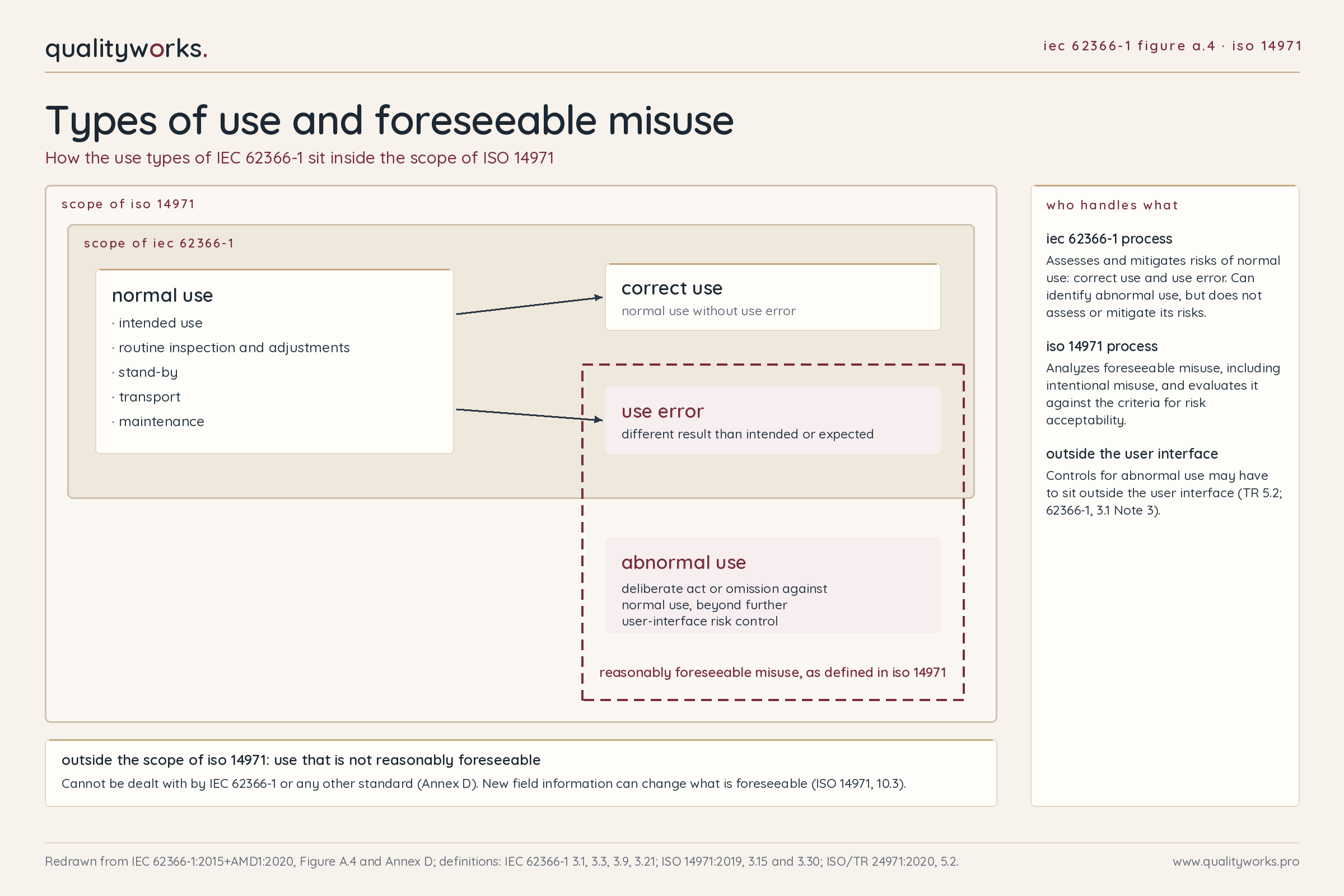
Normal use (clause 3.9). Operation, including routine inspection and adjustments, according to the instructions for use. Where there are no instructions, in accordance with generally accepted practice.
Correct use (clause 3.3). Normal use without use error.
Use error (clause 3.21 in 62366-1 and clause 3.30 in 14971). A user action or lack of user action that leads to a different result than the one intended by the manufacturer or expected by the user. This includes the inability to complete a task. Deviating from the instructions counts as a use error only if it leads to a device response different from the intended or expected one.
Abnormal use (clause 3.1). A conscious, deliberate act or deliberate omission of an act that is counter to normal use and is beyond any further means of user interface-related risk control by the manufacturer. The examples in the standard are reckless use, sabotage, and deliberate disregard of information for safety.
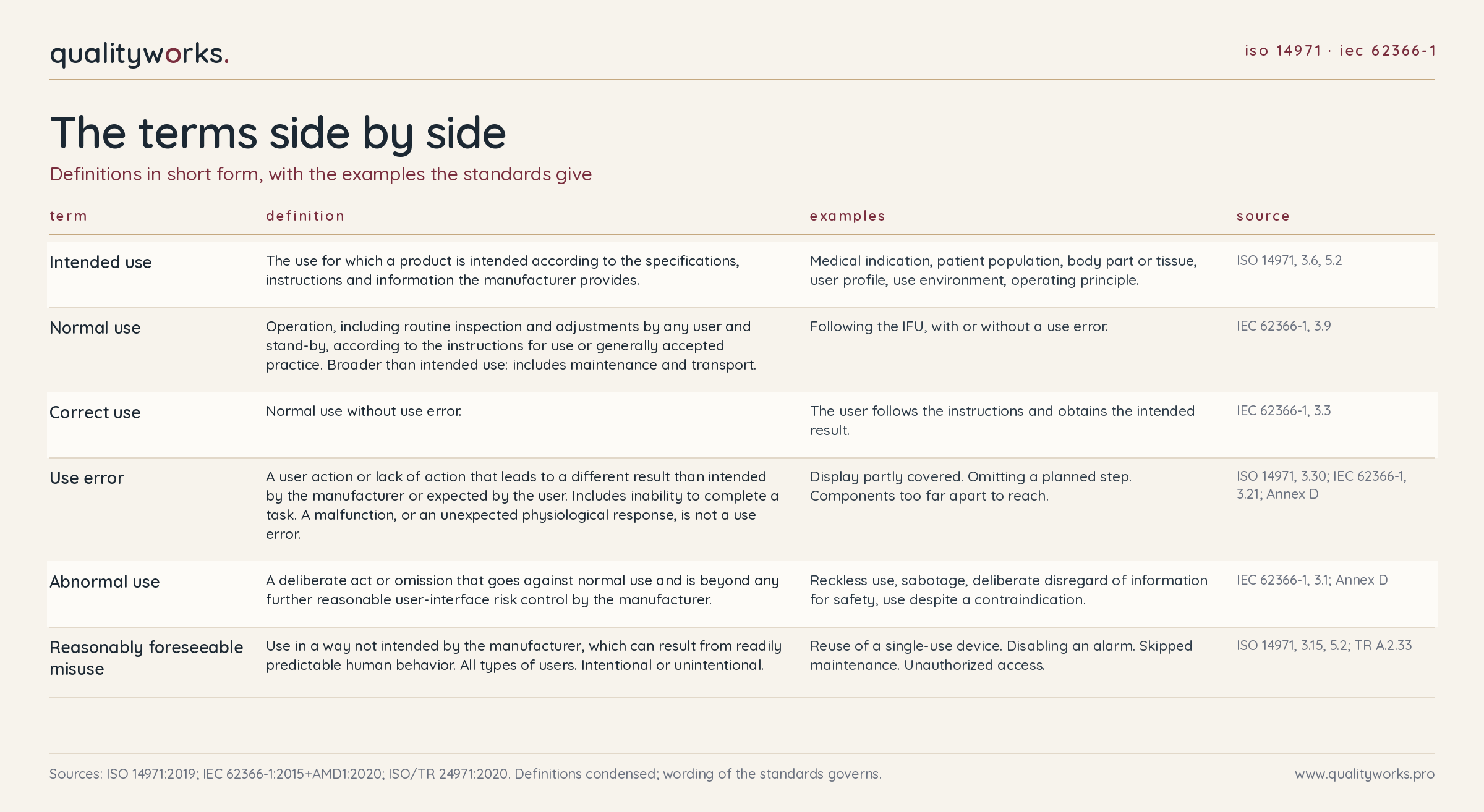
A use error can result from a perception failure, a cognitive failure or an action failure (Annex D of 62366-1).
Examples include a partly obscured display, omitting a planned step, or a distance between components that makes it hard to reach a control.
Whether something is a use error or abnormal use is also decided in studies.
According to 62366-1, a user's action or inaction in a usability test is considered abnormal use if the interview after the test shows that the user understood the correct use and consciously decided to act against it. If the user did not know what the correct use was, the accompanying documents or the training are probably not adequate.
How this connects to ISO 14971
The scope of ISO 14971 is broader than the scope of IEC 62366-1. The usability engineering process evaluates and reduces risks related to normal use, meaning correct use and use errors.
It can identify abnormal use, but it does not evaluate or reduce its risks. According to Figure A.4 of 62366-1, reasonably foreseeable misuse as defined in ISO 14971 covers both use errors and abnormal use. Use that is not foreseeable is out of scope, and according to Annex D of 62366-1 no standard can address it.
The example in the TR, in clause 5.2, illustrates this.
A single-use device is designed to be used only once, and warnings against reuse were included in the information provided with it.
Usability testing showed that the information is effective, meaning users understand the correct use and the risk. Even so, some of them will intentionally reuse the device. Intentional reuse is considered abnormal use, so it falls outside the usability engineering process, because its risks cannot be controlled in the user interface. It is also considered reasonably foreseeable misuse, so its risks are analyzed in risk management and evaluated against the criteria for risk acceptability. Risk control measures outside the user interface may be needed.
Note 3 to the definition of abnormal use in 62366-1 says the same thing from the usability engineering side: abnormal use does not relieve the manufacturer from considering risk control measures that are not related to the user interface.
MDCG 2023-3 gives, in footnote 17, the guidance to distinguish abnormal use from reasonably foreseeable misuse. There is no contradiction here, because these are two different concepts. Abnormal use is a usability engineering concept that separates what can be controlled in the user interface from what cannot, and reasonably foreseeable misuse is a risk management concept defined by whether the behavior can be predicted. As the TR example shows, the same behavior, such as intentional reuse, can be both.

What MDCG 2023-3 says about reporting
The classification affects reporting. MDCG 2023-3 Rev.2 (questions 5 and 6) states that:
A use error caused by lack of attention, a memory lapse, a mistake during use or a lack of understanding is not covered by the definition of an incident
A use error caused by the device's ergonomic features, such as the display, alarms, software menus or the user interface, is an incident. If it meets the criteria of a serious incident, it is reported under Article 87 of the EU MDR, and if not, it is subject to trend reporting under Article 88
Abnormal use is a deliberate violation of the intended use, for example off-label use by a healthcare professional. Information about abnormal use that reaches the manufacturer should be documented and handled within the quality management system. Such data can reveal systematic misuse or off-label use, help check that the intended purpose is appropriate, and show whether a field safety corrective action is needed
Reasonably foreseeable misuse must be documented in the quality management system.
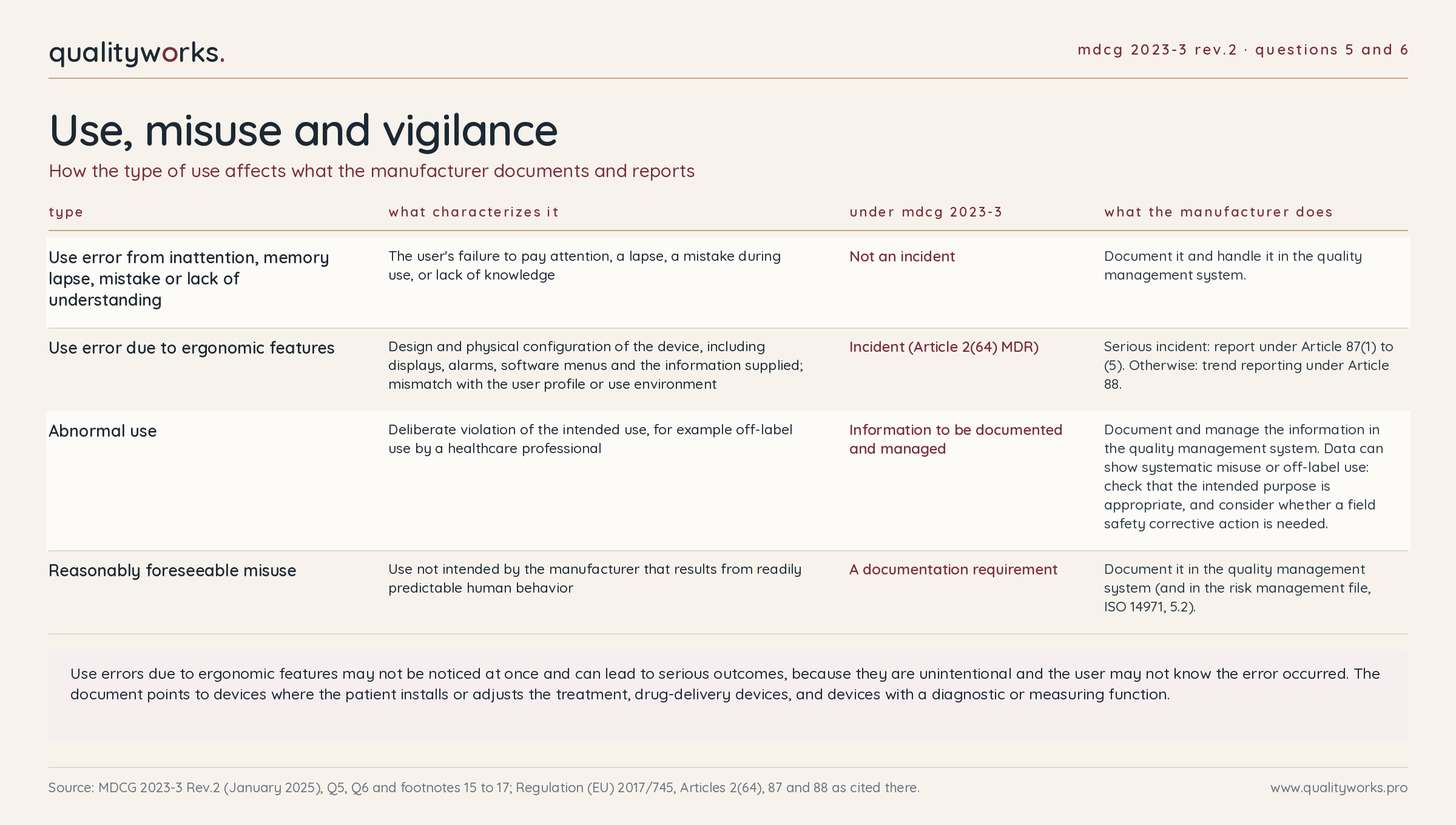
Telling an ergonomics-related use error apart from one caused by lack of attention relies on an analysis of the design.
The user interface includes every part of the device the user interacts with, as well as the information the manufacturer provides. A documented usability analysis therefore also supports the decision on whether an event is reportable.
Reasonably foreseeable misuse over the device's life
Knowledge about misuse grows over the life of the device. During development it comes from usability studies, and after the device is on the market from information about actual use. The standard requires the manufacturer to review the information collected, among other things for whether previously unrecognized hazards or hazardous situations are present (10.3).
If the information is relevant to safety, the manufacturer determines whether reassessment of risks or assessment of new risks is necessary (10.4).
This way, behavior that was not considered foreseeable at product launch can enter the risk management file as information from the field builds up.
What to check in your company
A startup before certification. Is the intended use written differently in different documents? Are all the indications, populations and environments that were not limited supported by data? Was reasonably foreseeable misuse documented by a team that includes real users or their representatives?
A company with a product on the market. Are complaints and abnormal use documented and classified using these terms? Is a use error classified as ergonomic or non-ergonomic based on analysis, rather than on a judgment made on the spot? Is field information about misuse reviewed under clause 10.3?
A company changing a post-market process. Does the complaint handling process distinguish between use error and abnormal use, and define where each type goes?
Single-use devices. Does intentional reuse appear in the analysis as reasonably foreseeable misuse, with a risk control measure that is not only information?
In the next article: characteristics related to safety, and identification of hazards and hazardous situations (clauses 5.3 and 5.4).