Risk Management: The Risk Management Plan and File
In the previous article, top management set a policy for risk acceptability. The risk management plan (clause 4.4) is where that policy becomes criteria and activities for a particular device, and the risk management file (clause 4.5) is where you can show that the activities were carried out.
The notified body also asks to see the plan and the outputs of the process when the technical documentation is submitted.
This article goes through clauses 4.4 and 4.5 and the matching guidance in ISO/TR 24971:2020, and adds what notified bodies write about them in their guidance on submitting technical documentation.
The risk management plan: what it is and how big it should be
The standard requires risk management activities to be planned, and a plan to be written for each device as part of the file (4.4).
The EU MDR also requires such a plan for each device, in Annex I, Section 3.
According to the TR, the plan can be a separate document or part of the quality management system documentation, and it can refer to other documents, such as the planning of clinical, biological and usability evaluations or the planning of post-production activities. The extent of the activities and the level of detail in the plan should match the level of risk of the device. The requirements in the standard are the minimum, and the manufacturer can add items such as a time schedule, risk analysis tools or a rationale for choosing particular criteria.
The plan is a living document. The TR says it should be reviewed and updated throughout the life of the device, and that information should keep being collected even after the last device has been sold.
Changes to the plan are recorded in the risk management file.
The whole plan does not have to be written at once, and parts of it can be developed over time (Note 4 in clause 4.4).
The seven elements of clause 4.4
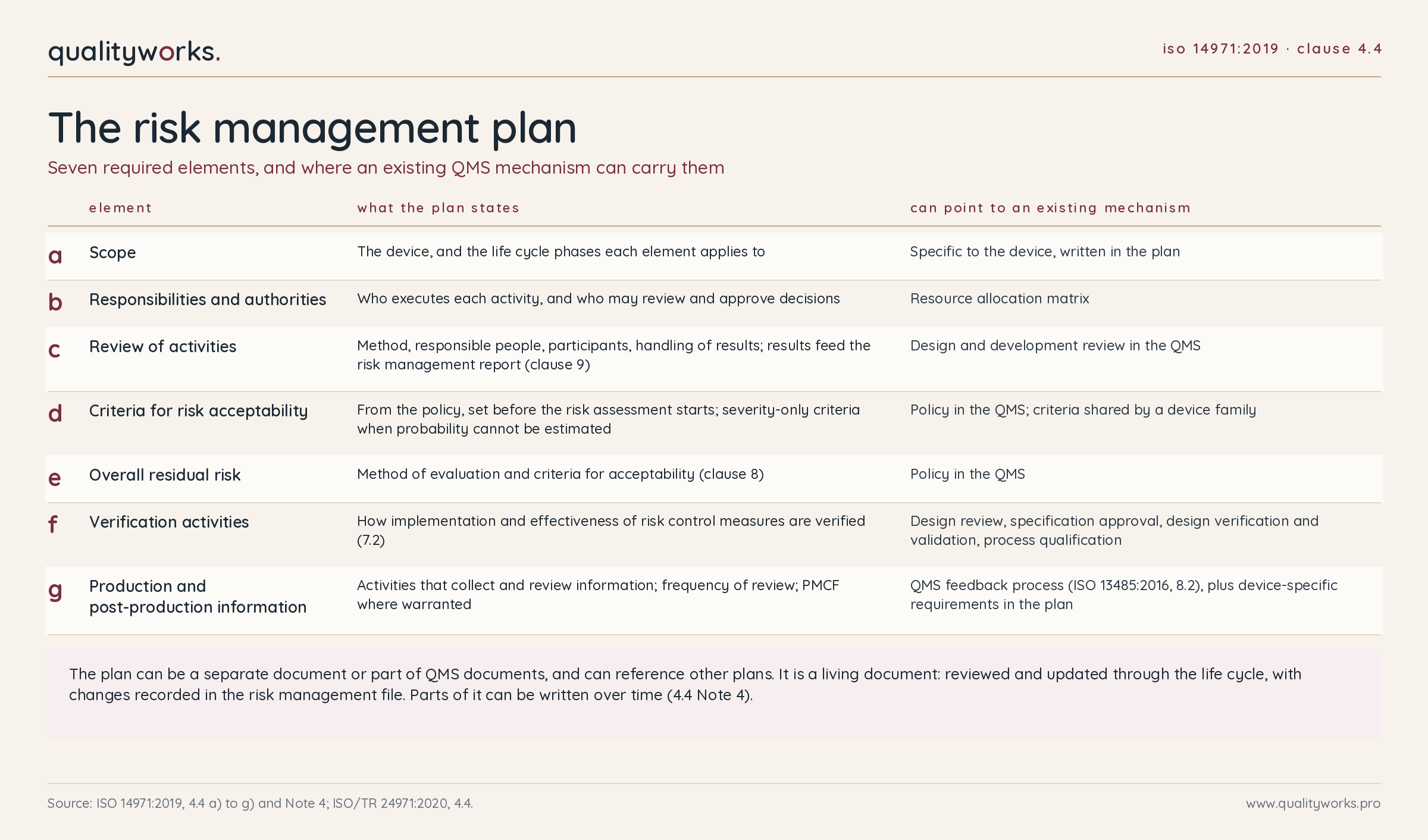
The standard lists seven elements that must appear in the plan. The infographic shows them, and where a reference to an existing process is enough.
Here are a few points from the guidance:
Scope (4.4 a). You describe the device and the life cycle phases to which each element applies. Some elements relate to product realization (design, development and production), and some to production and post-production, such as installation, use, maintenance and decommissioning (TR 4.4.2).
Responsibilities and authorities (4.4 b). Who carries out each activity, and who has the authority to review and approve decisions. This can be documented in a resource allocation matrix.
Review (4.4 c). The review method, the people responsible, the participants and how the results are handled. The results are consolidated in the risk management report (clause 9), and the requirement can be part of the design and development reviews in the quality management system.
Criteria for risk acceptability (4.4 d). They are derived from the policy, as described in article 2. They are set before the risk assessment starts, so that its results do not influence the decision, and they also include criteria for situations where the probability of occurrence of harm cannot be estimated, in which case you can rely on the severity of harm alone.
Overall residual risk (4.4 e). The plan for the device sets the method for evaluating the overall residual risk and the criteria for its acceptability. They are derived from the policy and defined in advance, before the evaluation. They can differ from the criteria for individual risks, because different risks have different severities and probabilities and cannot be added up numerically (TR 8.1). According to Note 2 in clause 4.4, the method can include gathering and reviewing data and literature on the device and on similar devices on the market, and the judgment of a cross-functional team with application knowledge and clinical expertise.
Verification (4.4 f). The plan sets out how the two verifications of clause 7.2 are carried out: the implementation of the risk control measures, and their effectiveness. They can be detailed in the plan or by reference to other plans. Verifying effectiveness may require clinical data or usability studies.
Collection of information (4.4 g). The system for collecting and reviewing production and post-production information. The TR asks for the extent to fit the device: limited monitoring can be enough for a device with a long history of use and well understood risks, while a novel treatment or innovative technology can justify broader monitoring, including post-market clinical follow-up (PMCF) studies. The frequency of review depends on the risk, the number of devices on the market, the number of reported incidents and the severity of harm. You can refer to an existing process in the quality management system (for example clause 8.2 of ISO 13485:2016), while requirements specific to the device and the details of the monitoring activities and of planned PMCF studies are written in the plan itself.
In addition to the seven elements, the standard requires the system for categorizing probability and severity (clause 5.5) to be recorded in the file. In practice it is usually written in the plan, and notified bodies also list it among the things the plan should include.
The risk management file
The risk management file is defined as the set of records and other documents produced by risk management (3.25).
The TR stresses that it is a logical construct: it does not have to physically contain all the records. References that allow the information to be assembled in a timely manner are enough, and the records can be part of quality management system files and in any format.
Timely matters, because the file is used throughout the life of the device to review post-production information, to evaluate the effect of a change and during audits.
Each clause of the standard states which record it adds to the file. The infographic brings them together.
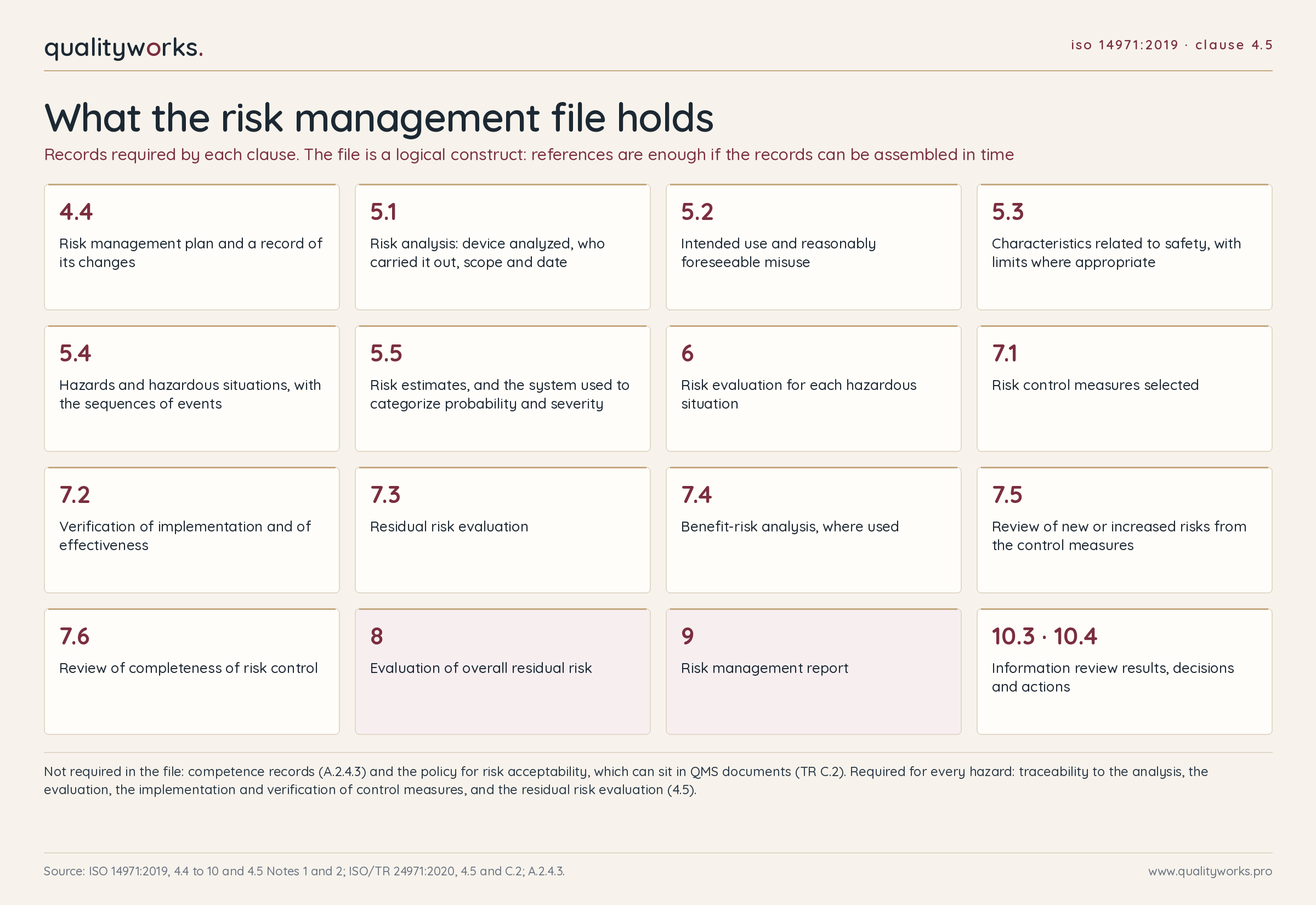
The records of the competence of the people involved in risk management do not have to be in the file, and the policy for risk acceptability can sit in the quality management system documents (Annex A of ISO 14971, A.2.4.3, for the competence records, and Annex C.2 of the TR for the policy).
Traceability for every hazard
Clause 4.5 requires traceability from each identified hazard to:
the risk analysis
the risk evaluation
the implementation and verification of the risk control measures
the results of the evaluation of the residual risks.
The rationale in Annex A: a task that was not completed can leave a hazard that was not examined or not controlled, and harm can be the result.
Traceability is the way to show that the process was completed for every hazard.
The TR suggests a traceability tool that serves as an index to every document in the file that holds information on a particular hazard. The index later helps with the evaluation of the overall residual risk and with the review of post-production information, and it should be updated when new information arrives or when the device changes.
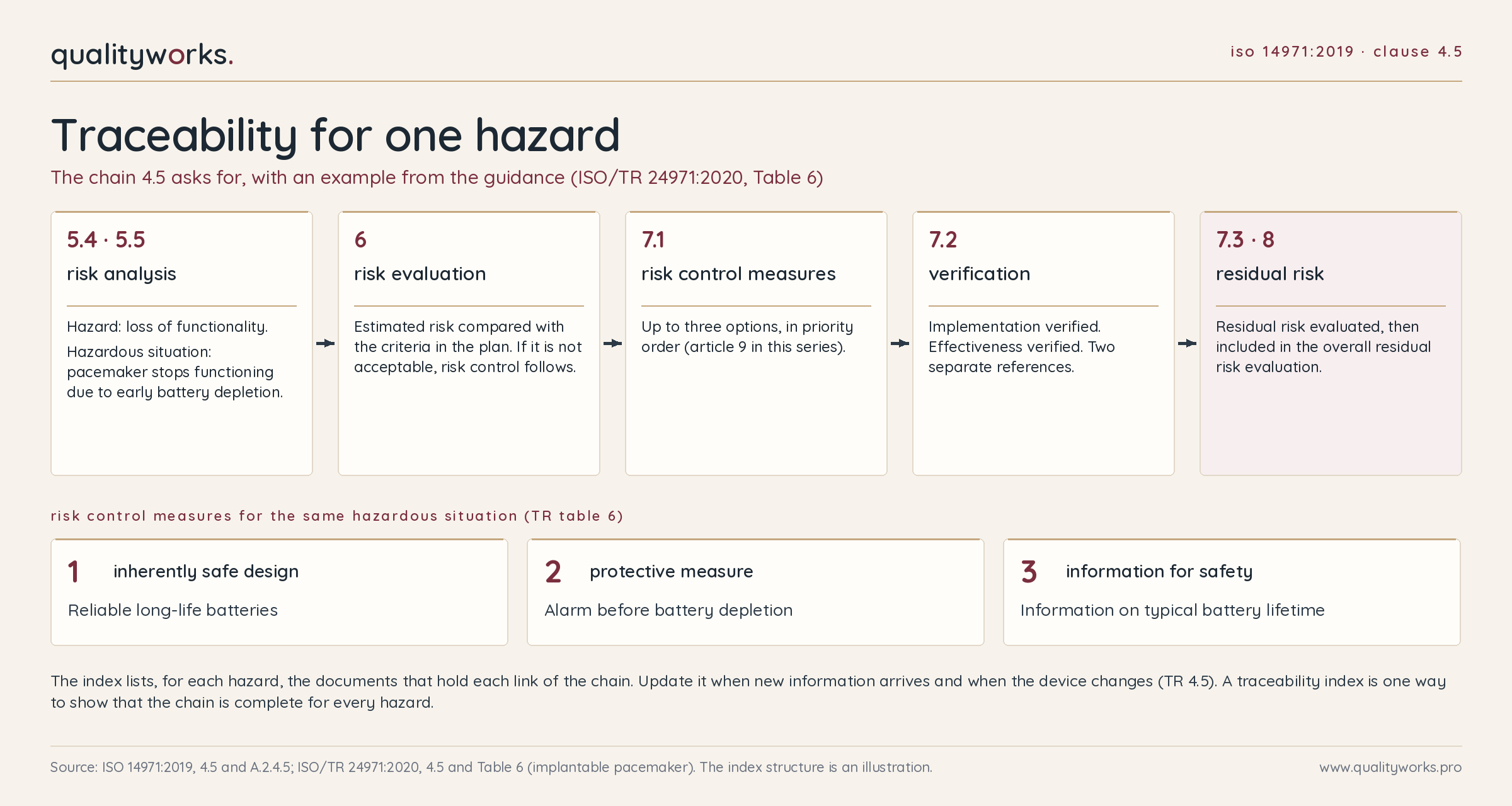
The example above is taken from Table 6 of the TR (pacemaker). Notice that it has three levels of risk control measures for the same hazardous situation: inherently safe design, a protective measure and information for safety. In a real index, each level would point to the verification of its implementation and the verification of its effectiveness.
What notified bodies ask to see
The Team-NB guidance on submitting technical documentation (version 4, dated April 21, 2026) is a working guidance of the notified bodies, not legislation.
Each notified body may ask for more information, but the guidance still shows what they expect in practice.
EU MDR Annex II, Section 5 requires the technical documentation to contain the benefit-risk analysis and the results of risk management according to Annex I, Section 3, and the Team-NB document lists which documents are attached:
A clear statement of whether the risk management process is based on EN ISO 14971
The risk management procedure, including the definitions of the rating systems and of risk acceptability, and the plan for the device with all the elements described here
Evidence that the risk management team is competent, including a clinical expert
A link between the verification and validation protocols and reports and the risk IDs, so it is clear which risks each document controls
A risk management report with the evaluation of the overall residual risk and the benefit-risk ratio.
The same document has a list of common failures. Here I show them, together with what you can do instead.
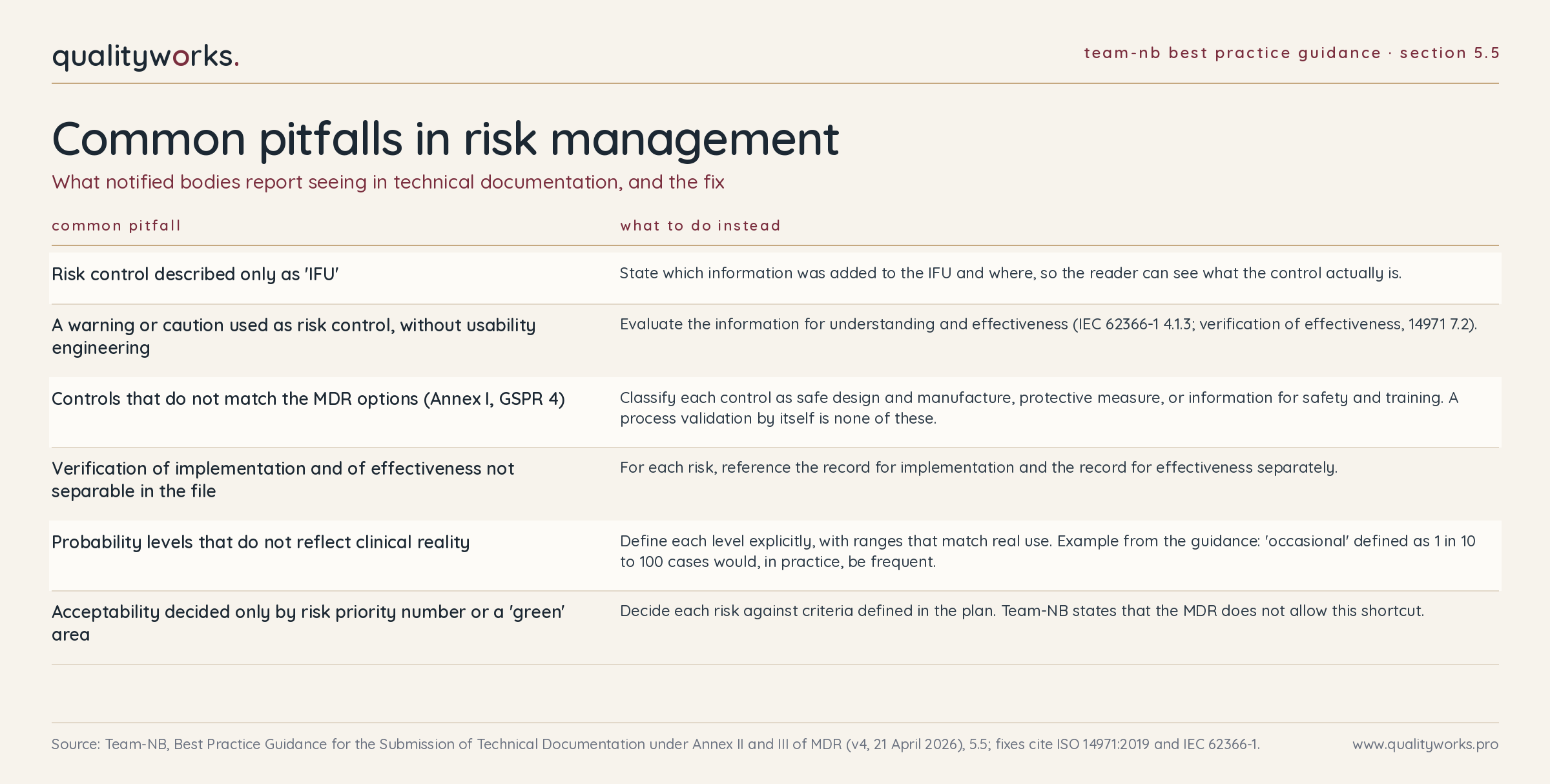
The last failure on the list relates directly to the plan.
According to Team-NB, the EU MDR does not allow risk acceptability to be decided only by a Risk Priority Number (RPN) or a green zone, and each risk is assessed against criteria set in advance in the plan.
What to check in your company
A startup before certification. Was the plan written and were the criteria set before the first analysis started? Does it refer to quality management system processes that already exist, instead of a new document that duplicates them? Are the activities for collecting information from the market tailored to the device, and not just mentioned?
A company with a product on the market. Are changes to the plan recorded in the file? Is the index updated when the device changes? Does every risk have a separate reference to the verification of implementation and the verification of effectiveness?
A company changing a post-market process. Does clause 4.4 g in the plan reflect the new process? Does the frequency of reviewing the information match the number of devices on the market, the number of incidents and the severity of harm?
Every company. Can the file be assembled in a timely manner, for example ahead of an audit?
In the next article: intended use and reasonably foreseeable misuse, the starting point of risk analysis.